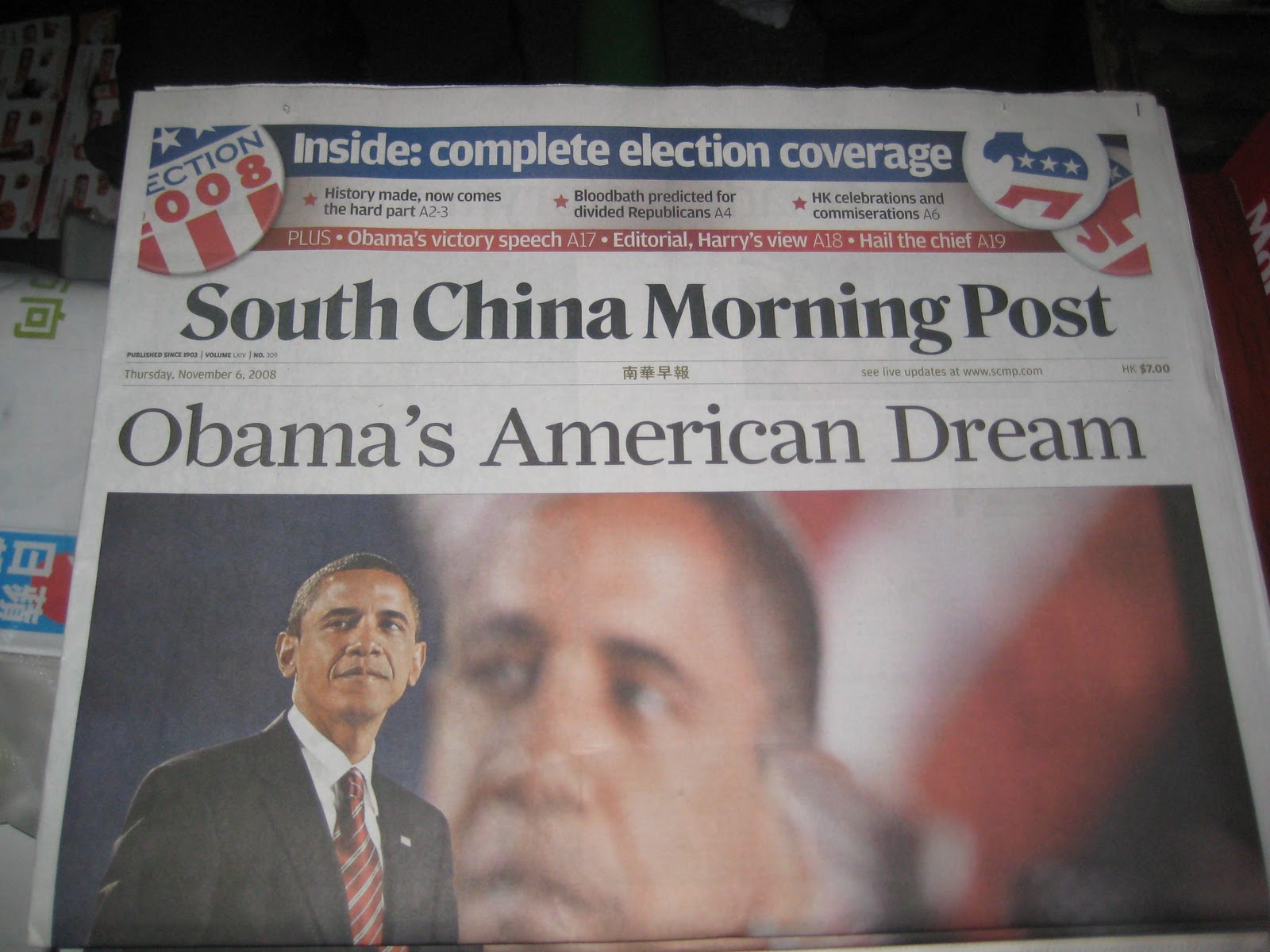
I don’t step onto land when I step off the ship in Hong Kong. Instead, I step into a hallway portal that spits me out into a fluorescently lit shopping mall. There’s a Starbucks next to Calvin Klein with a stack of newspapers on the counter all featuring Barak Obama’s face on the front cover. Today is November 13th, 2008.
It feels like a mile of window shopping before I see sunlight. I wait for the ferry from Kowloon Island to Hong Kong Island while Taylor buys an egg something from a street vendor.
We get off the ferry and onto a two-story cab/bus that weaves between skyscrapers that make me feel as if I’m inside of a video game.
We ride the trolley up to Victoria Peak.
We stroll the Hong Kong Botanic Gardens…
And Hong Kong Park.
We catch the ferry back to Kowloon Island…
so that we can catch the light show at nightfall.
Before the night is through we’ll go over the ferry once more to drink at The Russian Vodka room, a bar made of ice. Too bad I’m allergic to vodka. I went for the parka, anyway.
Showing posts with label photography. Show all posts
04 January 2011
16 November 2010
War Journalism: A Question of Ethics
An image at the War Remnants Museum has got me thinking about ethical journalism. It was a photo of a terrified family holding on to one another; the caption read that the photographer asked a firing squad standing out of the photo’s frame to hold fire so that he could take his shot first.
I think he exploited the family in their time of ultimate fear and confusion –at what point does documentation become dehumanization?
I went on to irrationally slander war journalists for passively witnessing cruelty for their work. I called them cowards. The writing, which I’ll respectfully exclude from Global Osmosis, reflects the frustration and sadness that I felt as I examined the gruesome, chaotic, devastating photos at the War Remnants exhibit. Ignorant to the extent of the war before visiting Vietnam, I was overwhelmed by its chronic impact.
I am a visual learner. It wasn’t until I could see the conflict (euphemism for carnage) between America and Vietnam, in the museum photos that I could even begin to comprehend it.
War photographers, as a whole, are far from cowardly. It would be hypocritical to nark on these journalists who have heightened my understanding of what exactly a war is. And in the same breath I still question where you draw the line and put down the damn camera.
I think he exploited the family in their time of ultimate fear and confusion –at what point does documentation become dehumanization?
I went on to irrationally slander war journalists for passively witnessing cruelty for their work. I called them cowards. The writing, which I’ll respectfully exclude from Global Osmosis, reflects the frustration and sadness that I felt as I examined the gruesome, chaotic, devastating photos at the War Remnants exhibit. Ignorant to the extent of the war before visiting Vietnam, I was overwhelmed by its chronic impact.
I am a visual learner. It wasn’t until I could see the conflict (euphemism for carnage) between America and Vietnam, in the museum photos that I could even begin to comprehend it.
War photographers, as a whole, are far from cowardly. It would be hypocritical to nark on these journalists who have heightened my understanding of what exactly a war is. And in the same breath I still question where you draw the line and put down the damn camera.
Posted by
Em Hutto
Labels:
photography,
Vietnam
3
comments
12 July 2010
A Place to be Savored
The Mekong Delta dominates Southern Vietnam. It's a 15,000-square mile network of channels and streams that empty into the Mekong River. Known as Vietnam's "rice basket," the region feeds the rest of the country, in essence. And it's the lush home for countless species, more than one thousand of them which were discovered within the last decade. Recent news articles spout conflicting opinions about the future of the delta, some in favor of mass preservation of the area, and others hoping to develop it with more extensive infrastructure. With 10 million tourists who have already visited this year, I'm not surprised the Mekong Delta is high on media radar.
I'm also not surprised at that striking number of tourists -it's a beautiful place. It makes for relaxing days of floating down canals on sam pam rowing boats while munching on sweet lychee fruit, swaying side to side in hammocks above the water to the sounds of banjo bands behind, and strolling through the waterside marketplaces. There is locally farmed honey and coconut candy called Que Dua to taste.


Life moves a little slower on the delta. It's simplistic. Neighborly. Archaic even. These photos remind me of the authenticity of that place, and the fact that it should be savored.
I'm also not surprised at that striking number of tourists -it's a beautiful place. It makes for relaxing days of floating down canals on sam pam rowing boats while munching on sweet lychee fruit, swaying side to side in hammocks above the water to the sounds of banjo bands behind, and strolling through the waterside marketplaces. There is locally farmed honey and coconut candy called Que Dua to taste.


Posted by
Em Hutto
Labels:
photography,
Vietnam
1 comments
12 April 2010
10.28.2008
I can't find the words to describe the most memorable sunset I've ever experienced. But I did just find the pictures.


Posted by
Em Hutto
Labels:
Malaysia,
photography,
sunset
0
comments
21 December 2009
Lion Hunting
I rode in a safari jeep for nearly 12 hours through Kruger National Park, eyes peeled for a fierce, majestic wildcat...
I finally spotted one behind a sheet of glass at the MGM Hotel
in Las Vegas.
in Las Vegas.
I'm still not quite sure how I feel about all this. At least safari made for some good photo opps.
Posted by
Em Hutto
Labels:
photography,
South Africa
0
comments
17 March 2009
Letters Home
I sift through journal pages and notice a common theme: letters.
My normal methods of communication ceased to exist during the trip; students were limited to a mere 2 hours of Internet for the entire voyage and my cell phone became a foreign object. In fact, I still forget it constantly after months of being home.
Far removed from my reality, in the middle of the ocean and unfamiliar territories, I think I reached out by writing to those whom I missed.
I wrote the first letter the same day of the flip-flop drop. With wet feet I traveled on a guided bus to the outskirts of Salvador and Bahia to the Saramandaia community. These outskirts communities are called favelas, which roughly translated in English are slums. The word slums, however is not only degrading but also presents a connotation of poverty that cannot even skim the surface of the depths of the conditions in Brazil. It even suggests a level of ignorance that the people living there might possess. What these Saramandaians lack in what I might call “formal education”, though, they compensate for in innovativeness and street smarts.
Upon arrival we met the leaders of the Grupo Cultural Arte Consciente, a grassroots movement devoted to reducing violence among children in the favela. Many community members teach the children boxing, acrobatics, dancing, drumming and painting to foster their skills and promote neighborhood peace.
On the way to Saramandaia I saw a man flying a kite on the highway. I saw another man riding his horse, weaving in and out of zipping cars. Culture shock was quickly setting in… and this letter is proof of my boggled mind that day.
Dear Professor
Before I left for my voyage, you advised me to “document, document, document.” You told me to take endless pictures so that I might use them in my future journalism endeavors, and you reminded me to always keep my audience in mind.
I’m afraid that I have already failed your mission on the first day in port at the first port of the journey. I’ve landed in Salvador, Brazil. My lack of prior knowledge about Salvador has sheltered me to the extreme poverty that I witness as I walk the streets of this favela. Skeletal children walk barefoot in dirt, scraps of metal and what I gather from scent can only be human waste. Mothers and countless children crowd into windows of shacks to watch a large tour bus of Americans invade their grounds. Tattered, ripped clothing lines the fences for hang drying.
Colorful. Chaotic. Filthy. Crowded. Disheveled. Perhaps the most shocking element is that these people are alive. The bold graffiti they paint on any visible surface throughout their neighborhoods reflects the reality of their being. The artwork sings a song, it dances to their drums, it tells their story. Every inch surrounding them become their canvas.
In your classes I’ve learned that my main objective as a journalist is to tell someone else’s story in the most vivid way possible. My job is to jot quotations, snap photographs and create a tale with my words and images. These tales then become my artwork. I cannot do my job as a journalist today. In order for me to “document, document, document,” someone else’s reality becomes my artwork. And I don’t feel quite right about it.
I’m putting the camera away for now. Instead of my lens I will use my eyes. The only audience I can document for right now is myself. I might not be doing my job as a journalist, but I think I’m doing my job as a human.
For more information about Grupo Cultural Arte Consciente, email Alex ou Fabio at programarteconsciente@hotmail.com
Posted by
Em Hutto
Labels:
Brazil,
photography
0
comments
Subscribe to:
Posts (Atom)